I learned early in life how to be in the water. When I was six years old, my mother enrolled my siblings and me in swimming lessons after my brother nearly drowned in a pool in Thailand. What began as a protective act by my mother became a path that shaped me as a young child in so much more than just a sport – an activity, a way to survive. I went on to become a Thai national swimmer, a breaststroker and a sprinter, racing the 50- and 100-meter events. In the pool, and under the guidance of a coach, I learned discipline, power, determination, getting back up after failures, and how to move efficiently through resistance.
My relationship with water as a young person was more around conquering —water was simply a medium in which I needed to learn how to push against and how to surge forward in short, explosive bursts. I wanted to be the best. I was determined to do whatever it took. Truth be told, I wanted to win the gold. And yes, I did win hundreds of medals and represented my country in many swim meets across Asia. I also did not win and I had to deal with a surge of emotions – disappointment, failure, and even wanting to give up. I remember one of my coaches telling me after I did not medal, how a winner isn’t someone who wins – a winner is someone who falls off the horse and is even more determined to get back up and try again. I learned how to give it my all, to never give up … and yes, sometimes you win, sometimes you don’t.
My relationship with water as a young person was more around conquering —water was simply a medium in which I needed to learn how to push against and how to surge forward in short, explosive bursts
Years later, in my early twenties, after my family had moved to St. Louis, Missouri, I felt called to meet water in a different way. I decided to learn how to scuba dive and began at Bonne Terre Mine—an underground world unlike anything I had ever known. The mine was a journey back in time: abandoned mining equipment, rusted railway tracks frozen where they had last been used, and a billion-gallon underground lake stretching through vast caverns. To begin a dive, you had to walk down hundreds of steps, descending nearly 200 feet below the earth before even touching the water. The lake itself was crystal clear, cold, and impossibly still.
I eventually became a safety diver there. When tourists came to dive the mine, my job was to ensure their equipment was safe and then position myself at the back of the group. Neon lights were attached to each diver’s tank, and in the darkness my task was simple and constant: count the lights. If there were ten divers, I needed to see ten glowing orbs ahead of me. In the cold, dark water, it was easy for someone to lose a sense of buoyancy and begin to sink. When that happened, I would dive down and pull them gently back up, restoring balance and orientation.
After some tourist dives, the more experienced staff divers would often continue on to parts of the mine closed to the public. I was capable, but still relatively new—especially to mine diving. One day, when I was asked if I wanted to join them, I felt hesitation rise in my body. And still, I said yes.
We descended to about 90 feet. The darkness was complete, broken only by the narrow beams of our lights. I followed the staff divers through tight spaces until we reached a passage just large enough for one diver to move through horizontally – only about three feet of clearance above and below. The staff diver in front of me moved through with calm, steady strokes. I hesitated for a moment. I had only dived in open water where I could surface at any time. This tight tunnel wasn’t that long. I told myself I can do this.
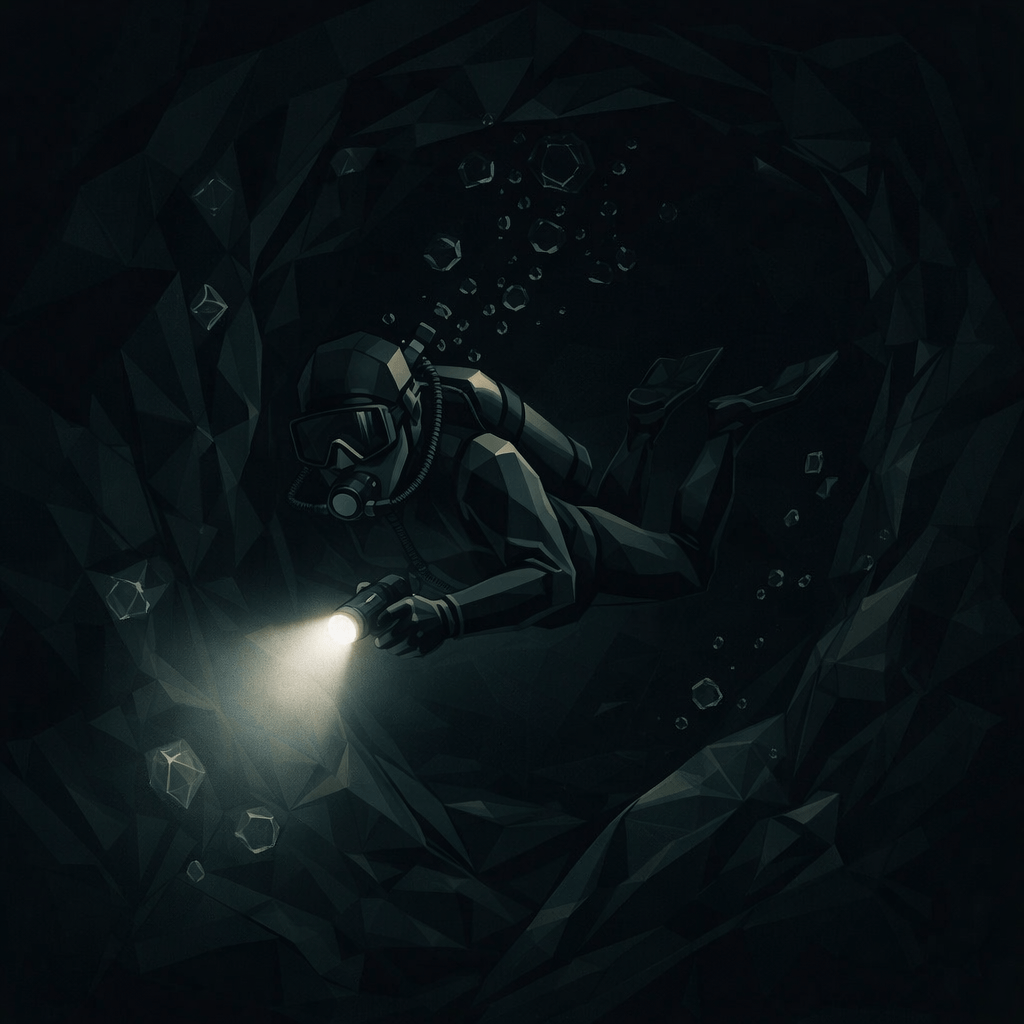
I entered the tunnel, 90 feet below the surface. Total darkness except for the beam of my light. As I moved through, my fins accidentally brushed the surface. Instantly, the silt exploded into the water. Everything disappeared. Total blackness.
Panic surged through me. I couldn’t surface. I couldn’t see. My body wanted to thrash, to escape. At the time, I had been practicing meditation daily for several years – a practice that had supported my sobriety, that had taught me how to sit with a busy mind, how to be still in the presence of persistent thoughts and addictive cravings. A practice of stillness and noticing, and returning to my breath.
In that moment, in the darkness, something in me remembered.
I spoke to myself clearly and firmly: Breathe, Marilou. Breathe. Be Still. Be still. Be still.
So I stopped.
I did nothing.
I trusted the water. I trusted the pause.
In the water … in the darkness, I learned to listen
I floated in the darkness of that mine, unable to see. (I later learned this is called silt-out – when water transforms from clear to a thick, opaque cloud of suspended sediment, leaving zero visibility.)
And once the water became clear again, and the silt had settled, I took a deep breath and continued through the tunnel and out into open water to join the others.
That moment taught me something competitive swimming never had. As a sprinter, I was trained to move fast, to exert force, to power through. There is a time for that. But in that mine, survival depended on stillness.
In the water … in that darkness, I learned to listen.
I believe the seed of a deeper philosophy was planted in there – a way of being I have come to embody over time: to Be like Water. To move when movement is needed. To soften when resistance arises. To trust the currents without losing myself within them. To meet each moment not with force, but with presence.
And within that, to trust Ma-the space between. The pause where nothing is forced and everything can emerge. The quiet interval where clarity returns.
And sometimes, to simply be still …
and to let what is unsettled, settle.
* In Japanese philosophy, there is a concept called Ma. It is often described as the space between—the pause between notes, the silence between words, the stillness that gives meaning to movement. It is not empty. It is alive, relational, and full of possibility